
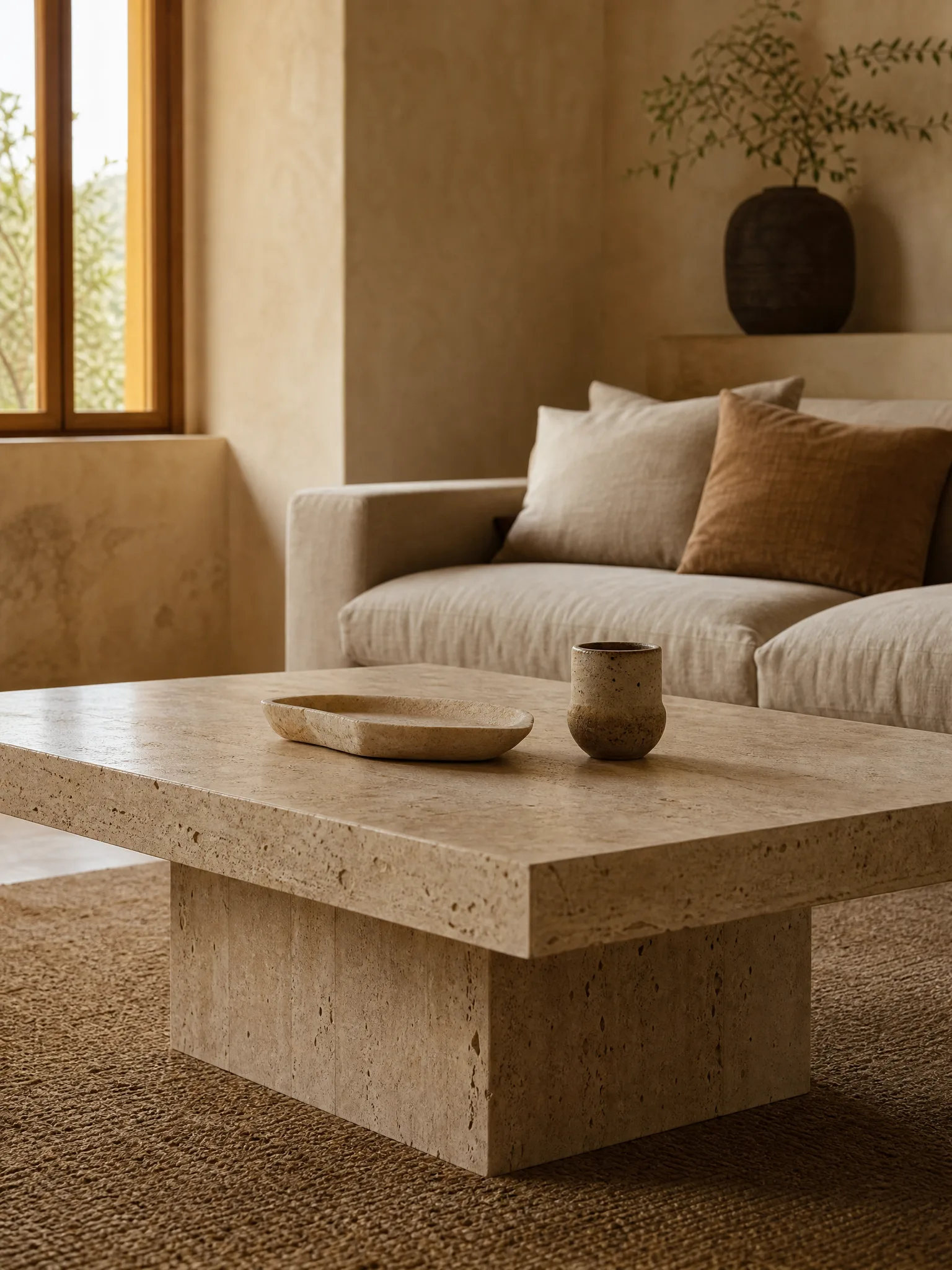
Travertine coffee table: what to know before you buy
Short answer: A travertine coffee table is an investment in a natural material that can last for generations — but quality varies enormously. The key things to check before buying: is it solid stone or veneer, is the surface sealed, how much does it weigh, and how are the edges finished. Here is the guide.
Why have travertine coffee tables become so popular?
Travertine captures two movements at once: the desire for natural, honest materials in the home — and the calm, sensuous look where furniture is sculpture as much as function. The pores, veins and warm tones make every table unique, and unlike high-gloss marble, travertine has a matte, grounded expression. Read more about the stone in our guide What is travertine?
Solid travertine or veneer — how to tell the difference
The most important question of all. Many cheap “travertine” tables are MDF or honeycomb aluminium with a few millimetres of stone glued on. Three quick checks:
- Weight: Solid travertine is heavy — a full-stone coffee table typically weighs 40-80 kg. If one person can lift it easily, it is unlikely to be solid.
- Edges: Look at the underside and the edges. With veneer you can often see the joint as a thin line where the stone layer meets the core material. Solid stone has the same structure all the way through — pores and veining continue around the edge.
- Sound: Tap the tabletop gently. Solid stone gives a dense, dead note; cavities and composite ring hollow.
Veneer is not necessarily a scam — it makes large furniture lighter and cheaper — but the price should reflect it, and the seller should disclose it honestly.
Five things to check before buying
- Sealing: Travertine is porous limestone. If the surface is not sealed, red wine, coffee and oil soak into the stone. Always ask whether the table is delivered sealed and how often the treatment must be repeated.
- Filled or open pores: Some tables come with filled pores for a smooth surface, others with open pores for a raw look. Neither is wrong — but open pores gather more dust and demand more care on a table in daily use.
- Weight and floors: 40-80 kg demands stable floors and effort when moving. Check whether the table stands on feet or directly on the slab — direct contact can scratch wooden floors.
- Finish: Honed (matte) travertine is timeless and hides wear; polished stone shines more but shows scratches and etching clearly.
- Returns and shipping: Heavy furniture is expensive to return. Check shipping both ways and the delivery form (kerbside vs. carry-in) before you buy.
What does a travertine coffee table cost?
The price level often reveals the construction: under roughly DKK 3,000 you are usually looking at veneer or composite. Solid tables of good quality typically run from DKK 5,000 to 15,000 depending on size and finishing, and designer editions can cost far more. The vintage market (such as 1970s Italian travertine tables) is a chapter of its own — beautiful, but demanding patience and knowledge.
Caring for a travertine coffee table
The rules are the same as for all travertine objects: wipe with a soft, slightly damp cloth, avoid acidic cleaners and liquids — citrus, wine and vinegar can etch the stone — and always use coasters under glasses and cups (our Orbit Coasters are made for exactly that — stone protecting stone). We have gathered it all in our travertine care guide.
Start with the small objects
A coffee table is a big decision — in price and in the room. Many therefore begin by inviting travertine in at a smaller scale: a sculptural object on the existing coffee table, a low bowl in solid travertine or coasters in solid travertine that protect the tabletop and bring the material into daily use. That way you learn whether the calm of the stone suits your home — before committing to 60 kilos of it.
See our full collection of travertine objects — designed in Copenhagen, solid stone, no veneer.

